Chapter 5:
Why Carrying Unforgiveness Is Killing You
I ended the last chapter with a beautiful story of forgiveness. I’m going to start this one with a terrible story about unforgiveness. In the late 90s a series of evangelical novels was published that became extremely successful for their two authors. Each made millions of dollars from book sales. Before they became so successful, the film and television rights for the first two books in the series were sold to two young, Christian businessmen. These individuals were complete novices about Hollywood film and TV production. Signing with a production company that wasn’t known for quality work, they produced a film based on the first book. Frankly, it was pitiful. When I saw it, the worst thing about it was the fact that it didn’t even bother to present the message of salvation in Jesus Christ in any significant way, a message that was certainly in the book.
When he saw the film, one of the authors, whom I will call the Bible teacher, became enraged. This man had published several very good Christian books on his own before he co-authored the wildly successful novels. He was so angry that he decided to sue the two young businessmen. The grounds that he claimed for the suit? They had verbally promised him a 45 million dollar film and the film they had produced cost less than five million.
During this time, these young businessmen approached me about creating a TV series based on the books. They assured me that I would have freedom to write and produce the series as I felt it should be done. I began writing scripts. A friend with much experience in production joined with me to sell the project. Together we began having meetings with major production companies in Hollywood. Because of the success of the novels, there was real interest. Lionsgate was one of those companies. Our scripts went out to the interested organizations for reading. Although they were very Christian in their message, the readers’ reports were excellent. Which is always unusual in Hollywood. But as our meetings continued, we encountered the lawsuit. Lawsuits are the kiss of death for any Hollywood project.
This was very discouraging, but, suddenly, there was a ray of hope. A production company that wanted to be involved in the series arranged for a meeting to take place between the two young businessmen and the Bible Teacher. They asked me to lead the discussion and try to arbitrate between the parties. What an assignment. The day came and I drove 250 miles from my home in the mountains to Los Angeles. The meeting was held in the production company’s boardroom. Present were the two young businessmen, the Bible teacher and his wife, who was herself a national evangelical leader, and the teacher’s literary agent, who at that time was the most successful agent in the evangelical publishing world.
I began the meeting with prayer and then asked each person to tell of their experience in meeting the Lord and how that had changed their lives. Then we talked about the film that had been produced. I agreed with the Bible Teacher that the quality had been very poor and, worst of all, the message of salvation was almost non-existent. Given the teacher’s background I felt that this had to be his most serious issue. Certainly, it was mine. I assured him as the creator and showrunner of a TV series based on his book, every single episode would clearly present the salvation message. It would go out to a world that desperately needed to hear it. Also, every episode would be done with production excellence. I could make that promise based on the work that I had done in Hollywood for years.
The discussion continued for several hours. At a certain point the teacher’s wife asked him to go out into the hall with her. They talked privately for some time. Finally, they came back in and the teacher announced that he was going to drop the lawsuit. Praise God, what an answer to prayer. On the way out of the building, the teacher’s agent took me aside and told me that this was amazing and wonderful. He was so glad. As I drove back the 250 miles, I was ecstatic thanking God for such a miraculous outcome. To the best of my ability, the series would be excellent. Jesus was going to be lifted up. But when I arrived home, it all came crashing down. There was a message waiting on my answering machine. The man had changed his mind. The lawsuit was back on.
It continued for years, totally destroying any possibility of a TV series. From a friend who knew all the details, I heard how it ended. The Bible teacher became enraged with the man assigned by the court to arbitrate and make a final decision in the case. He was a retired judge. The teacher called the man and said, “You’ve taken long enough. I want a decision now.” The reply he got? “You want a decision now? You have one. You lose.”
Over the years of this lawsuit, both Christian parties wasted a combined total of 80 million dollars. The Bible teacher’s lack of forgiveness damaged everyone involved in all aspects of the project, including the two young businessmen and my team that had been working hard for months on TV scripts. All of those scripts just went in the trash. Even more tragic, news of the lawsuit got out to many executives in Hollywood, helping to destroy any possible Christian witness. Obviously, Christians were no better than anybody else, in fact they were worse. All their talk about God was just hypocritical blather. Money, power, arrogance, rage and a thirst for revenge all worked together to create a message from hell. Both the Bible Teacher and his wife are dead. I hope he repented before he died. One more thing I should make clear. The other author of the books did not approve of the lawsuit or participate in it.
Afterward, in thinking about that man, I had some serious forgiving in prayer to do. It was a challenge to pray for him. So what does it mean to forgive? Here is a dictionary definition: Forgiveness means to excuse a fault or offense, to pardon, to renounce anger and resentment, to absolve from the payment of a debt. So someone has attacked you and seriously hurt you in some way. You have determined that the person has sinned against you. That sin could be anything from besmirching your character to something far worse. In your mind, you have sustained real injury. Perhaps it was to your reputation or your sense of peace and security. Perhaps you are living with the hell of false accusations that everyone believes. Perhaps it was physical abuse that has polluted your memory and emotions. Or maybe it was done to someone you love. There are many possibilities, but what was taken was important.
There are people who think forgiveness is based on emotion. “I can’t forgive until I feel forgiving.” Since they never feel forgiving, they never forgive. And let’s be honest. It feels good not to forgive. I get dark satisfaction from nursing the anger that comes with evil memories and desires. To give that up takes the very Power of God. I have heard people say, “I’m just not ready to forgive.” That may be honest, but it’s just as foolish as saying, “I’m not ready to give up the cancer that is killing me. I’m going to enjoy it awhile longer.”
True forgiveness starts by realizing and accepting the fact that it is not based on emotion at all. It is an act of the will. Someone owes you a debt because of the injury that he or she has inflicted. The person hasn’t admitted it and maybe they won’t. You are preparing for a confrontation with the individual. Spiritual failure is guaranteed if forgiveness is not an essential part of your preparation.
But what does forgiveness require? It requires kneeling before God in prayer and placing a person into His Hands, trusting Him to be the Righteous Judge. As an act of faith, it requires giving up your right to exact payment for the debt that a person owes you. It means renouncing your right to be angry any longer.
Though deep emotion is involved, true forgiveness is a judicial act. As a judicial act, it is made once. But very likely, you will have to remind yourself of that decision many times. When memories return, hurt returns and anger with it. Each time, you choose to remind yourself of the decision you made and give that person to the Lord. Though it may be reaffirmed many times, the act of forgiveness is accomplished once.
Imagine that you are a judge in a court. The prisoner, the person who has sinned against you, stands shackled in the dock. Forgiveness is setting that person free, letting him walk out the door of your mind unchained. A year later, you don’t run after him, dragging him back and chaining him up again for the same offense. You may want to do that, but when you do, you remind yourself of the decision that you made. You recommit him into God’s Hands, praying blessing upon him. In a sense, the person who has sinned against you is a prisoner that you are holding in the dungeon of your mind. As you set him free, you are freeing yourself, because as long as he is kept in that dungeon you are imprisoned with him.
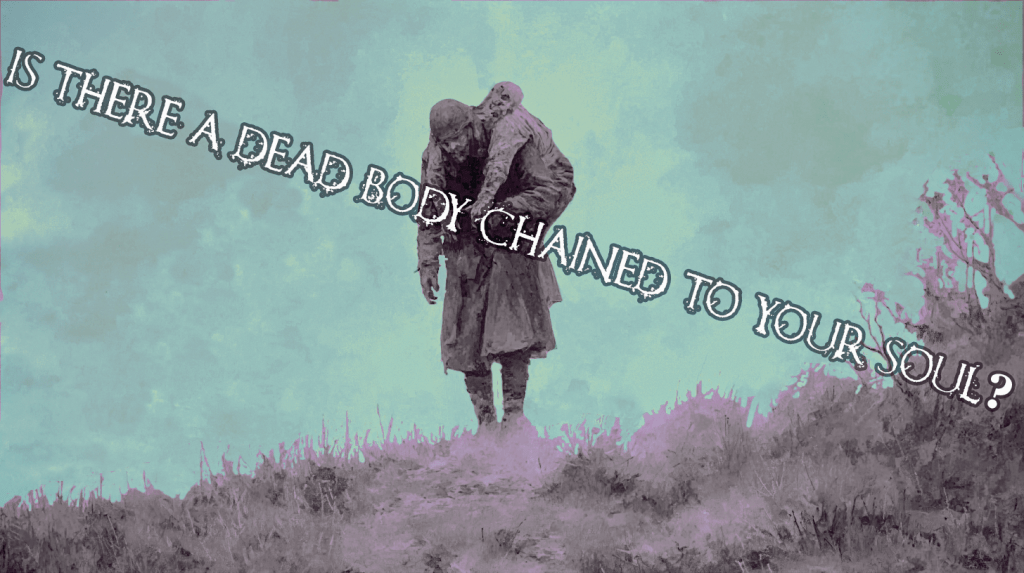
In the Middle Ages, a terrible justice was exacted on murderers. The dead body of the victim was strapped to the murderer’s back to rot until it killed him. When we do not forgive, it is as though the dead body of the one we hate is strapped to our soul. As it rots, it kills us with anger, bitterness and self-pity. The most horrible reality is that Satan can make that rot actually taste good to a soul on its way to hell.
But even knowing all of this, there are many who will say, “I have a right to my anger and desire for revenge. Why should I give it up? My anger protects me. If I give it up, I’ll just be hurt again. Doesn’t the Bible say an eye for an eye? And the one who did this to me hasn’t asked to be forgiven anyway, so I don’t need to forgive him until he does. Isn’t that what the Bible teaches?”
Many times, this leads to disastrous confrontations. Because we believe that we don’t need to forgive until the perpetrator asks to be forgiven, we decide, “I’ve got to get this individual to acknowledge and accept what he has done to me. Then, maybe, he’ll ask to be forgiven. Unless that happens, my wound will never heal and I don’t have to forgive.”
Wrong.
This puts forgiveness and healing into the hands of another person who may never want forgiveness and who may even be dead. As long as we believe this lie our wounds will never heal. Could Jesus have taught something that would put us into such a bind? He didn’t. So what did He really teach about forgiveness? That’s for the next chapter in this journey. Your assignment? Let’s turn all of this around. Is there someone in your life that you have sinned against, someone that you need to go to and ask to be forgiven? Do you need to make restitution for something you have taken? Pray for God’s wisdom about all of that. Also, keep reading your Bible and praying every day.
Bible Study and Small Group Discussion Questions
- Why does unforgiveness feel so justified and even “good”in the moment?
Passage: Ephesians 4:31–32, “Let all bitterness and wrath and anger… be put away from you… forgiving one another, as God in Christ forgave you.”
Question: Coleman describes the “dark satisfaction” of nursing anger. Why is bitterness so seductive, and what does Paul say it does to the soul? - How does unforgiveness destroy more than just the relationship between two people?
Passage: Hebrews 12:15, “See to it… that no root of bitterness springs up and causes trouble, and by it many become defiled.”
Question: The lawsuit in the story damaged reputations, ministries, witness, finances, and even outsiders’ view of Christianity. Where have you seen bitterness ripple outward like this? - The essay says forgiveness is a “judicial act,” not an emotion. What does that mean biblically?
Passage: Matthew 18:21–35, The parable of the unforgiving servant.
Question: How does Jesus’ teaching reinforce the idea that forgiveness is a decision of the will, not a feeling? What does it look like to “decide once” but reaffirm that decision many times? - What does the metaphor of the dead body chained to the murderer reveal about unforgiveness?
Passage: Proverbs 14:30, “A tranquil heart gives life… but envy rots the bones.”
Question: How does holding someone in the “dungeon of your mind” imprison you as well? Where have you seen this in yourself or others? - Why is placing someone into God’s hands essential for true forgiveness?
Passage: Romans 12:19, “Beloved, never avenge yourselves… ‘Vengeance is mine, I will repay,’ says the Lord.”
Question: Coleman emphasizes surrendering the right to collect a debt. What makes this so difficult, and what does trusting God as Judge practically look like? - Is it biblical to wait for someone to repent before forgiving them?
Passage: Mark 11:25, “Whenever you stand praying, forgive, if you have anything against anyone…”
Question: Jesus commands forgiveness in prayer, not after the offender repents. How does this challenge common assumptions about reconciliation? - How does unforgiveness distort Christian witness?
Passage: John 13:35, “By this all people will know that you are my disciples, if you have love for one another.”
Question: Coleman showed in the essay how the lawsuit harmed the credibility of Christian testimony in Hollywood. How does public or private bitterness undermine the gospel? - What does it look like to forgive someone who has deeply wounded you but is unrepentant or even dead?
Passage: Luke 23:34, “Father, forgive them, for they know not what they do.”
Question: How does Jesus’ example reshape our understanding of forgiveness toward those who never acknowledge their wrongdoing? - The essay ends by turning the question around: whom have you sinned against?
Passage: Matthew 5:23–24, “First be reconciled to your brother…”
Question: Why is it often easier to focus on people who hurt us than on those we have hurt? What steps of restitution or repentance might God be calling you to take? - What spiritual practices help cultivate a forgiving heart over time?
Passage: Psalm 139:23–24, “Search me, O God… and lead me in the way everlasting.”
Question: How do prayer, Scripture, confession, and community help uproot bitterness before it takes hold?
 Thorncrown Studios